Pauline Steinhorn
Introduction by Menachem Rosensaft
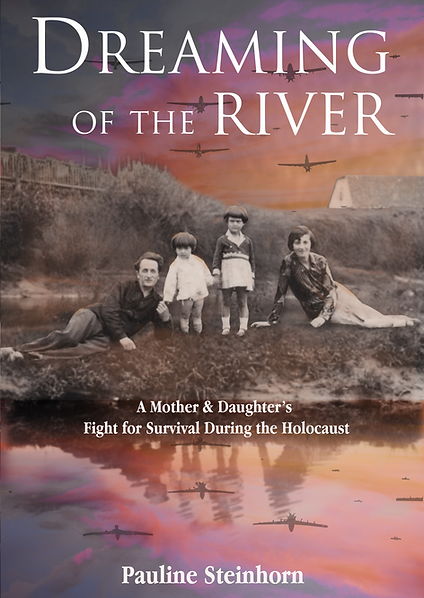
Bronia Feldman never imagined she would become the backbone of an underground medical lifeline, least of all inside the brutal forced-labor system of the HASAG munitions factory in occupied Poland. Torn from her family in September 1942, she arrives there, shattered by grief. The only force strong enough to keep her alive is the chance to save others.
Left behind in the ghetto of Skarzysko-Kamienna are her husband and two young daughters. Her 13-year-old daughter, Hajuta, has been sent to a nearby labor site. Bronia seizes a rare opportunity to escape and manages to reach her daughter. After their brief reunion, she faces an impossible choice: flee into the forest to join the partisans, or slip back to the place she has just escaped.
When they are reunited months later, the moment is both miraculous and heartbreaking. Hajuta is no longer the girl Bronia remembers. Together, they endure still darker days when they are deported to Bergen-Belsen in January 1945.
This true story of a Jewish mother and daughter is a testament to courage, devotion, and the fragile thread of hope that sustained them. Amid cruelty and terror, they also encounter moments of humanity.
Throughout it all, both cling to memories of the River Kamienna, where they once danced, played music, and believed in a future. For Bronia and Hajuta, the river is more than a memory. It is a promise that they might one day return home.
Dreaming of the River was published by Amsterdam Publishers in April 2026. Purchase the book from Politics & Prose, Bookshop.org, order from Amazon or Barnes & Noble.
About Pauline Steinhorn

Throughout her career as an award-winning filmmaker and writer, Pauline wrote and directed documentaries for PBS, Maryland Public Television, Sesame Street, Discovery Channel, the U.S. Holocaust Memorial Museum, and the Smithsonian. Her essays have appeared in The Wall Street Journal and Moment magazine.
Dreaming of the River is based on the journals of Pauline's mother and grandmother. It’s the true story of how a woman and her daughter survived and saved others in brutal bomb-making slave labor camps and Bergen-Belsen through sabotage, daring escapes, and rescues from near death—often with the help of unlikely allies.
Pauline is a Board Member of Generation After DC, a nonprofit network of Jewish Holocaust survivors, their children and descendants. When she’s not writing or directing, she shares her family’s Holocaust experiences at synagogues, countywide Yom HaShoah commemorations, and in middle and high school classrooms. She lives with her husband, Bill Creed, in Chevy Chase, MD.


Upcoming Events
July 7, 2026, Salt Lake Dirt podcast with host Kyler Bingham, Literary, Film & Music podcast on Spotify. Air Date TBD
July 9, 2026, Discovery Village, Chevy Chase, MD. Please contact Pauline if you'd like to attend.
July 27, 2026, 7:00 pm, Politics & Prose Bookstore in conversation with Deborah Kalb, 5015 Connecticut Avenue NW, Wash, DC 20008
August 26, 2026, Cover to Cover with host Mary Elizabeth Jackson, Brushwood Media Network
Past Events/Reviews
June 22, 2026, Senator Bill Bradley American Voices, SiriusXM TBD
June 16, 2026, LIVE 9 p.m. ET, Jason Myles Interview, This Is Revolution podcast
June 14, 2026, GenAfter DC Book Group on Zoom.
June 11, 2026, A Moment with Erik Fleming Podcast. Mr. Fleming served in the Mississippi House of Representatives from 2004 to 2016. https://www.podbean.com/media/share/pb-4dc65-1aeb5dd?utm_campaign=admin_episode&utm_source=episode_share_pb&utm_medium=dlink
June 4, 2026, Book Talk at Ashby Ponds, 44795 Audubon Square, Ashburn, VA
You can watch the hour-long PowerPoint presentation on Ashby Ponds Community TV
https://cloud.castus.tv/vod/ashby-ponds/video/6a21c3cd57f5420002f0841c?page=PLAYLIST
June 1, 2026, Newport Mill MS, Kensington, MD.
June 1, 2026, Lewis at Large, KLWN Radio (Lawrence, KS) Air Date TBD
May 29, 2026, "A moving account of human resilience." Read David Luhrssen's review in the Milwaukee Shepherd Express: bit.ly/4dDh7Ur
May 29, 2026, McLean High School, McLean, VA.
May 26, 2026, Book Group, Marriottsville, MD.
May 21, 2026, Wootton High School, Rockville, MD.
May 18, 2026, Am Kolel Community Book Talk, in person & via Zoom.
May 13, 2026, Night Talk with Kevin Tocci, WATD Radio. Air Date TBD
May 12, 2026, Rick Flynn Presents Podcast. Air Date TBD
May 11, 2026, The Lifestyle Show, Talk Radio Europe. Spain's largest English-speaking radio station.
May 5, 2026, Morning Show with Greg Berg, WGTD, NPR Station, Kenosha, WI. On their Podcast
https://www.wgtd.org/playlist/morning-show/ms-dreaming-river.
May 3, 2026, 9:00 am, Temple Emanuel Library Interview with Rabbi Adam
10101 Connecticut Ave., Kensington, MD. 20895
May 2, 2026, Book Q&As Blog with Deborah Kalb
https://deborahkalbbooks.blogspot.com/2026/05/q-with-pauline-steinhorn.html
April 30, 2026, The Bookman's Corner with Lois Lindstrom
https://www.youtube.com/watch?v=lQY33wm18l0
April 29, 2026, Morning Wake Up News Live, WVBT Radio, Taunton, MA
April 28, 2026, On Second Thought with Chuck Boozer Live, WHKY Radio, Hickory, N.C.
https://drive.google.com/file/d/1L-RPJU0EQSszdAuyrU7KLTpqSHV7mDyJ/view
April 28, 2026, Cowboy State Daily Show LIVE airs throughout Wyoming.
Watch at 22:35. https://cowboystatedaily.com/2026/04/28/morning-show-with-jake-april-28-2026/
April 28, 2026, Frost Middle School in person, 4101 Pickett Rd., Fairfax, VA
April 26, 2026, Book Launch at The Writers Center, 4508 Walsh St., Bethesda, MD 20815
April 16, 2026, Bethesda Chevy Chase HS, Bethesda, MD.
April 12, 2026, Temple Emanuel, 7th graders and their families, Kensington, MD.
March 24, 2026, The Public Eye with Al Vuona, WWDB, NPR Station, Worcester, MA.
https://wicn.org/podcast/pauline-steinhorn/
March 6, 2026, The Brian and Lee Radio Show, WICN, Philadelphia, PA.
Watch 20:30 minutes in: https://wwdbam.com/episodes/the-brian-and-lee-show-interview-with-author-pauline-steinhorn-03-06-26/
Praise from Readers
“I have always chosen to interview authors and guests who either write non-fiction or have lived through an experience. Fiction allows for too much exaggeration, while non-fiction and real-life experiences must adhere to what actually took place. Pauline Steinhorn’s story brought to life a period in history that is real, affecting so many people both then and today.”
—Al Vuona, writer, public speaker and host of The Public Eye, WICN’s NPR Station, Worcester, MA
“Seldom do writers on the Holocaust have access to diaries from both a mother and her daughter. With these materials in hand, Pauline Steinhorn crafted a wonderful book about her mother and grandmother, retelling, often in their own voices, the story of their struggles—together and apart and together again—from the ghetto of Skarzysko-Kamienna to the forests and slave labor camp, then to the Bergen-Belsen concentration camp in the days when the Typhus epidemic that took the lives of Anne and Margot Frank in the winter of 1945, was lethal to many thousands. Trained medically, Bronia Feldman is indispensable to the inmates and even useful to their masters, who need their workers to work. Heroically, daringly, courageously, she tries to save those who can be saved and protect her fellow Jews if at all possible. Bereft of her husband and two younger daughters, who were deported from the ghetto, she fiercely protects her oldest child, Hajuta, who at 13 must become a woman to survive for a time on her own. The story is told with accuracy and grace. It is a work to be savored. And though it probes the depths of darkness with brutal honesty, it also explores rare moments of compassion and decency by the perpetrators and the intense struggle for survival.”
—Dr. Michael Berenbaum, Distinguished Professor of Jewish Studies and Director of the Sigi Ziering Institute, American Jewish University
“There is almost a cinematic quality to Dreaming of the River. The details in Pauline Steinhorn’s descriptions take the reader to each location during their harrowing journey through the camps of Poland and Germany. You can see the ghetto, the barracks, and the forest. And you can feel their emotions as well. They drive home the themes of family, perseverance, and uncertain survival. There are countless books written about the Holocaust, but none that I know of mirror the perspectives of a mother and her teenage daughter. Pauline Steinhorn has done a remarkable job of curating and weaving their stories together in a riveting fashion.”
—Cliff Hackel, Emmy, Peabody and Dupont award-winning filmmaker and producer of My Dear Children, a pogrom-era documentary
“In Pauline Steinhorn’s stunning Dreaming of the River, the River Kamienna, a mute but eloquent character, keeps alive happy recollections of the years before the Holocaust turned its fury upon Ms. Steinhorn’s family. In the words of Hajuta, a young woman forced into inhuman slave labor by the Nazis, 'These memories would keep me alive. God was still here. There was life beyond this.' Dreaming of the River is a book bold, bruising, and brave."
—Martin Goldsmith, author of Alex's Wake: The Tragic Voyage of the St. Louis to Flee Nazi Germany--and a Grandson’s Journey of Love and Remembrance
“In this important account, Pauline Steinhorn recounts her mother’s and grandmother’s remarkable story of survival, from the Skarżysko Ghetto to the HASAG labor camp and eventually to Bergen-Belsen. Survival at HASAG often depended on acts of kindness by individuals who, in unimaginable circumstances, never lost their humanity. This eloquently written story of women’s resilience, strength, and hope is profoundly inspiring and reminds us that there can be light even in the darkest of times.”
—Stacey Saiontz, Granddaughter of Holocaust Survivors; Member, United States Holocaust Memorial Museum Education Committee; Member, Board of Directors, The Anne Frank Center USA
“Remember what happened here. Remember and tell the world.” I will not soon forget the words spoken to Pauline Steinhorn’s mother by other concentration camp inmates who thought she had a better chance to survive than they did. They were right. Hajuta made it out alive, as did her mother, Bronia. Their courage and determination live on in Steinhorn’s powerful new book. Steinhorn’s mother and grandmother were subjected to great cruelty during the Nazi occupation of Poland. But they had a fierce will to live, helped by occasional captors who showed them grace, much as Bronia used her skills as a nurse on friend and foe alike. This is an inspiring story to read and, yes, to remember.
– Jeffrey L. Katz, author of Unsettled Ground: "Reflections on Germany’s Attempts to Make Amends."
“I’ve been intrigued and charmed by this story since Pauline Steinhorn’s excerpt appeared in the Wall Street Journal. Now, readers everywhere can enjoy the full tale in this important and compelling work.”
—Peter Lovenheim, author of "In the Neighborhood" and "Gift Shop of Gratitude"
“Dreaming of the River effortlessly transports readers to Poland during WWII, focusing on the plight of one Jewish family. The author's writing style is engaging and immersive, and captures the characters' anguish and despair during a time of war and turmoil. The writing is excellent, and the story is both heart-wrenching and inspiring. Pauline Steinhorn has written an emotional and captivating story that will linger with readers long after they finish it.”
—Leslie K. Barry, screenwriter, author, and executive producer of "Newark Minutemen," a bestselling historical crime drama and soon-to-be motion picture
“Two years after Pauline Steinhorn finished editing her mother’s Holocaust journals, she discovered those of her late grandmother. The book she had originally planned to write about her mother’s harrowing—and inspiring—experiences became much more than that as she intertwined her mother’s and grandmother’s stories into a riveting narrative. Ms. Steinhorn describes in aching detail how the two not only survived but made it possible for others to survive. A powerful and beautifully written book.”
—Dena Hirsch, Daughter of two Holocaust Survivors; Generations After DC Board Member; Member, Jewish Community Relations Council's Holocaust Commission
EXCERPT
Growing Up with Holocaust Stories
When I was young, I often tiptoed into my parents’ bedroom to look at the jewelry and trinkets on my mom’s dresser. I was also fascinated by the framed black-and-white photos, many of children. One of my favorites was the one of six smiling girls bundled up in a snowy yard. When I asked who they were, my mother pointed to the tallest one and said, “That’s me. I was ten.” “
Where do they live?” I asked, pointing to the other girls.
“They’re gone. Murdered by the Nazis,” she said.
I didn’t fully understand her answer, but the cloud of pain that crossed my mother’s face convinced me to never ask about them again. I wondered if that was why she cried during the night. I often visited those photos when no one was around, trying to understand who these girls were, what games they played, and why anyone would want to hurt them. That black-and-white snapshot of six smiling girls in their winter coats broke my heart, if a six-year-old heart could be broken.
My imagination was my solace in those days and the years that followed, that and the company of my brothers. Allan was born when I was 2½. Around the same time, my grandmother, Bubbe and her son, Teddy, moved in with us. Teddy was two months younger than me and the product of a marriage to an older man with grown children who believed he was finished with diapers. My grandmother, like many Holocaust survivors, desperately wanted to start a new family even though she was almost forty. She thought her husband would warm to the idea. After all, how can anyone resist a baby? Somehow, he did. The only thing Bubbe carried when she moved into our home was her shoeless two-year-old, my Uncle Teddy.
Bubbe became a second mother to my brothers and me. At bedtime, she told us happy stories about sailing to Sweden with Mom after the war. During the summer, they swam in a lake. In the winter, they skied cross-country at night, gliding along trails illuminated by lantern light. Since Teddy called her Mom, I sometimes did too.
I often came home from school to find Bubbe cooking salmon cakes on the stovetop. Around the holidays, our home was filled with the sweet aroma of her homemade apple cake, Mandelbrot (Jewish biscotti) and brisket. Food was her love language. Her face lit up whenever we asked for seconds.
Although my mom’s friends called her Harriet, Dad called her by her Polish name, Hajuta (Hi-yu-ta) or “Hi” for short. My American father’s sole raison d’être was to make my mother happy. Dad said we should never do anything to disappoint her or make her sad. She had experienced enough sadness for a lifetime.
My father had a bag of tricks to make her laugh. One rainy afternoon, he lined up Teddy, Allan and me and showed us how to raise our eyebrows up and down in unison. On cue, when Mom came into the room, all brows fluttered. Although she laughed, she admonished us, saying our eyebrows would get stuck high up on our foreheads if we did this again. That never stopped us. When my youngest brother Mark was born, he joined the lineup.
My father continued his mischief, often sneaking up behind my mother while she washed dishes, grabbing her around the waist and kissing her neck. She would giggle and whisper, “Not around the children.” That never stopped him.
She may have laughed during the day, but most nights, I woke up to hear Mom crying and Dad’s soothing voice, reminding her it was just a bad dream. I discovered the source of my mother’s daily nightmares the day the woman in the dark green suit came. Strangers never visited, especially women wearing suits. Mom sent us downstairs to the playroom. She watched us until we reached the bottom of the steps, then told us to stay there until she called. Then she closed the door. She never closed the door. I climbed back up and sat on the top step. I didn’t understand everything they said, but over the course of weekly visits from the woman in the suit, I learned about Mom’s life in wartime Poland.
Mom’s stories became my stories. I dreamt of running through the forest away from the heavy footsteps of German soldiers, and being trapped in a packed cattle car with Mom and Bubbe. In that cattle car, women prayed and moaned while others shouted words of encouragement. When I woke gasping, the train whistles I heard were confusing. Was I on a train headed to a concentration camp, or was that the B&O train lumbering over the tracks near our rowhouse in Northwest Baltimore?
In the 5th and 6th grades, I took the trolley to the Enoch Pratt Library with my brothers. While Allan headed to the joke book section and Teddy searched for novels by Ian Fleming, I combed through the card catalogs for anything I could find about the Holocaust. Every week, I’d sit on the floor of the adult stacks and read until it was time to leave. With each book I read, I imagined Mom and her sisters fighting for survival with the other characters. I grew up on Holocaust stories. But unlike the books and DC comics I devoured as a child, not everyone who was good survived.
By the time I was in high school, my mother was speaking about her Holocaust experiences at synagogues, churches and schools. When my friends visited, Mom told them Holocaust stories at the kitchen table over milk and cookies. They were mesmerized by the tales of heroic escapes… rescues from near death… and teen girls whose bonds of friendship helped them endure the horrors of slave labor and concentration camps.
Talking about the Holocaust and remembering those who died became her raison d’être. She survived to tell her story, she’d say, so that it wouldn’t happen again.
In 1945, shortly after she was liberated, Mom wrote an almost daily account of her wartime experiences. She translated it into English, edited and re-edited, but it remained incomplete. When she was diagnosed with cancer, she felt an urgency to finalize it. I did too. A pencil and a pile of loose-leaf paper lay on a table beside her bed. Some pages were blank, others filled, and some held notes on earlier chapters. I typed her chapters and asked questions. In the last months of her life, when there was an alarming rise in Holocaust denial and antisemitism, she expressed regret at not finishing her memoir.
In early summer 2019, Mom showed me her final chapters, nearly 60 handwritten pages, along with over 220 typewritten pages. I promised to finish it for her.
A few weeks later, she passed away peacefully at home, shortly after our family gathered for her 90th birthday. I didn’t realize it at the time, but her legacy would become mine.
Over two years later, after completing an edit of my mother’s journals, I discovered my grandmother’s journals. Here were over 250 typewritten pages, also written in 1945, translated from the original Yiddish. I had no idea this treasure existed, nor did I know her history.
Bubbe passed away in 1994. I wished she were still alive so I could ask her questions and tell her how proud I was of her. Whenever I asked Bubbe about the war, all she would say was: “I wouldn’t have survived without your mother.”
I was familiar with some of the stories. Others astonished me. The book I imagined became something else entirely. Up until that point, I only knew this world through my mother’s teenage eyes. Now, I had my grandmother’s powerful narrative written from the point of view of a wife, mother, nurse and resistor. The coming-of-age Holocaust story I imagined would now include the story of my new hero, a woman who maintained her humanity, spoke her mind, and saved lives under the worst conditions.
Bubbe wasn’t afraid of anyone, perhaps because of all she endured. After my family moved to the suburbs of Washington, DC, Bubbe moved into our rowhouse in a neighborhood that gradually became run-down. All of our friendly neighbors moved away. Some houses became vacant, and the city stopped maintaining the streets as it once did.
Mom wanted Bubbe to move, especially after she was approached by a “young thug,” as she called him, in an alley when she walked home from the local grocery store. The “thug” pointed a knife at her and demanded money. Bubbe put two bags of groceries down and said, “I live in that house,” she pointed to the back door. “I just came from the A&P. Do you think I have any money left? Now, put away that knife and leave me alone.” She picked up her groceries and walked through the gate into her home without concern. Knowing this about my grandmother helped me understand her fearlessness in the concentration camps.
Writing this book was born from a promise I made to my mom. Through her public speaking, essays, plays, and now this book, she honored her vow to remember those who did not survive, those who showed her kindness and generosity, and those who risked their lives so she could live.
That responsibility now falls on me. I am honored to share my family’s story about the dangers of fascism, antisemitism, and genocide. Despite the inhumanity they faced, the most valuable lessons Bronia and Hajuta taught my brothers and me are to embrace life, love family, and stand against prejudice and injustice, just as they did.